 Geilt
The Cloud Computer Moat: Why Frontier Labs Want Your Agent's Disk

Over the last year, the frontier AI labs have quietly executed a major strategic pivot.
We started with lightning-fast local developer tooling: focused command-line interfaces, language server integrations, and local processes that executed tool calls directly against our own trees. You gave an agent an instruction, it inspected your files, made targeted edits, and handed control back to you. The model was a stateless computation engine: a fast, disposable reasoning layer operating on your hardware.
Almost overnight, that model was sidelined. Today, every major frontier lab is aggressively steering users toward hosted "cloud-computer agentic platforms."
Unlike a stateless web chat that streams text into a browser tab, or a local CLI that executes tool calls on your machine and shuts down, a cloud-computer agent platform provisions a vendor-hosted remote virtual machine. It comes equipped with its own persistent cloud disk, an always-on background runtime, a virtual display, and an autonomous agent harness capable of executing multi-step jobs long after you close your laptop. We see this architecture arriving under different banners across the entire industry: xAI’s Grokbot, Meta’s Muse, OpenAI’s Dot (paired with Codex Cloud), and Anthropic’s Claude Duet and Claude Cowork.
Alongside this push has come a bizarre, frustrating fragmentation: the same lab will offer a web chat interface, a desktop application, and a CLI client, each operating on completely different backends, with different context limits, mismatched feature sets, and segregated memories.
To accelerate adoption, labs have deployed an aggressive economic lure. They bundle these cloud-computer agents "for free" into existing subscription tiers, frequently touting "unlimited" autonomous execution or offering a generous "separate usage pool" that doesn't eat into your primary hourly prompt quotas. The pitch is irresistible on the surface: why burn your local laptop battery or hit your tight desktop rate limits when you can offload your codebase and tasks to an always-on cloud machine on the vendor's dime?
The catch is that once your work is moved onto their remote VM, you enter an absolute black box.
Hosted cloud platforms provide zero visibility into what model, checkpoint, or thinking level is actually executing under the hood on any given turn. You have no way to verify whether your prompt was routed to a frontier reasoning model, a quantized distillation, or an experimental internal branch. The internal mechanics of the cloud harness are entirely opaque: there is zero explanation of how context is compressed, how system prompts are injected, or how workspace state is mutated between turns. And the billing accounting is deliberately obscure; tasks silently consume opaque credit pools, weekly allowances, or unmetered throttles with zero itemized auditing.
Why the sudden, coordinated rush to move our agentic execution off our local machines and onto vendor cloud disks?
It isn't about giving you more compute. It is about two structural realities that frontier labs are desperate to solve.
The Two Structural Motives: Trajectories and Lock-In
The first driver is training data exhaustion. The public web has been scraped clean. Every blog post, GitHub repository, Reddit thread, and Wikipedia revision up to the present day has already been tokenized, compressed, and absorbed into base weights. Frontier models have plateaued on static synthetic text. To train the next generation of reasoning models, labs don't need more prose; they need high-quality, multi-step agentic execution trajectories.
They need to see how a human and an agent collaboratively debug a bizarre race condition across a ten-step tool-use sequence. They need to observe which compiler error messages caused an agent to back off, how file trees were navigated, which terminal commands failed, and how the prompt was adjusted to recover. When you run an agent in a vendor's hosted cloud VM, every keystroke, bash command, file diff, and workspace artifact lives on their physical disks. The telemetry is pristine, pre-formatted training data. Notice the ubiquitous, persistent nudges in these cloud interfaces asking you to "share workspace telemetry" or "improve model quality." Your daily problem-solving is the fuel for their next pre-training run.
This trajectory capture does not stop at your IDE or terminal. Once raw internet text ran dry, the big tech play became capturing ambient human context wherever work and life happen. A close friend of mine was recently raving about a wearable AI recording pin he had purchased, excitedly telling me that the best thing that ever happened to the device was Meta acquiring the startup; slashing the service cost from $300 a month down to zero. I told him to take the pin off whenever he was around me. It was only after talking through the economics that his mind was blown: he realized that the sudden "savings" were merely the subsidy for turning his daily physical life into unmetered training fuel (reflection on X).
The playbook for hosted cloud computers like Meta's Muse or OpenAI's Dot is identical. When a platform offers persistent virtual machines, background compute, and multi-gigabyte disks for "free" or heavily discounted, you haven't scored a bargain. You have merely agreed to let an AI conglomerate install a wiretap across your entire development lifecycle to feed their next frontier training cycle.
The second driver is manufactured vendor lock-in. Frontier model weights have near-zero switching costs. If an API provider degrades performance, introduces aggressive censorship, or hikes pricing, switching your code from one API to another takes an afternoon. An API key is an interchangeable commodity.
A persistent cloud disk however, is a moat. Once you let a vendor host your agent's workspace files, its scheduled jobs, its connector credentials, its persistent history, and its markdown-based memory stores, switching costs skyrocket. You can't just change an endpoint; you have to evacuate a VM. By trapping your active environment inside their infrastructure, vendors ensure customer stickiness just as they prepare to cut usage quotas, reduce weekly allowances, or impose rate-limit throttles.
Even worse than switching costs is the arbitrary gatekeeping that accompanies proprietary cloud harnesses. When you rely on a vendor's hosted environment, you subject your operations to heavy-handed compliance filters and sudden verification hurdles with zero recourse.
I experienced this firsthand while evaluating OpenAI's ecosystem. I had genuinely enjoyed using Codex's desktop client, iOS application, and advanced voice interface for coding workflows. But the moment I attempted to run a routine, defensive security audit against my own production codebase, the system tripped an opaque classifier. The session instantly froze. To add insult to injury, the platform actually deleted the agent's planned steps from the conversation history, wiping out the context of what it had intended to do so I couldn't even inspect why it had been flagged.
The application then redirected me to Daybreak, an external identity verification gatekeeper, which summarily denied my registration without providing a single explanation, a support path, or any mechanism to appeal (receipt on X). I have been working in IT since 2007. I run a technology company, build commercial software every day, and maintain an impeccable operational record. Yet an automated gatekeeper decided I was guilty until proven innocent, leaving me completely stranded.
When you outsource your development loop to a vendor's walled garden, "trust us, we know what is best for you" quickly becomes a mandate with no recourse. That experience was a definitive wake-up call: you simply cannot stake your business or your engineering velocity on any frontier vendor that holds the power to lock your workspace or shut down your tools on a whim.
The Four Hidden Costs: Blast Radius Contagion, Privacy, and Silent Drift
Handing your development environment to a vendor's hosted cloud disk introduces severe architectural and business risks that most teams ignore until disaster strikes.
1. The Account-Kill Blast Radius
When your execution environment, persistent file system, project schedules, and session history all reside behind a single vendor account, your business continuity is pegged to an automated Terms of Service classifier.
Frontier providers operate under extreme regulatory and legal scrutiny. They deploy blunt, automated heuristic classifiers that scan prompt inputs, workspace files, and execution outputs. If an automated filter flags a line of legacy test code, a vulnerability scan, or a sensitive data payload as a false positive, your entire account is suspended instantly.
With an API-based workflow, an account ban is a nuisance: you switch endpoints and resume work. But when an agent lives on a vendor cloud disk, an account freeze locks you out of your workspace, severs running services, and vaporizes your multi-week session histories with zero human recourse and no enterprise SLA.
2. Shared-Pool Contagion: The "X Ultra" vs. "Grok Heavy" Bait-and-Switch
The blast radius of hosted cloud computers isn't limited to account suspensions; it extends directly into quota cannibalization and operational contagion across your daily tools.
A textbook case study played out recently in the xAI and Cursor ecosystem with the transition from the legacy Grok Heavy plan to the new "X Ultra" tier.
Under the old and now unattainable Grok Heavy subscription, power users enjoyed strictly segregated, isolated usage boundaries: you had dedicated allowances for Cursor Ultra (which included bundled access to non-Grok frontier models like Claude Opus), independent usage limits for the Grok CLI, and a separate allocation for Grokbot. A heavy agentic experiment in one tool had zero impact on your ability to write code or run CLI jobs in another.
Then came the marketing sleight-of-hand. xAI introduced the new X Ultra tier, pricing it $100 cheaper than Grok Heavy and aggressively positioning it as the new flagship offering while quietly retiring Grok Heavy. On paper, a $100 price drop looks like a win for developers. In reality, it was a massive downgrade engineered to force customer lock-in and extract token fees:
First, it stripped bundled access to non-Grok frontier models like Claude Opus from the Cursor Ultra benefit, relegating third-party models to expensive pay-per-token metering. This was likely to save on compute and pass-thru costs since xAI owns the compute Grok runs on.
Second and far more dangerous, it collapsed the previously isolated tools into a single, shared usage pool. Under X Ultra, your Cursor IDE, your Grok CLI, and your hosted Grokbot cloud computer all draw from the exact same bucket.
When I confronted @grok on X about the rationale behind this consolidation (exchange on X), asking what compelling use cases remained for Cursor Ultra under the unified X Ultra plan when developers are trapped on the same Grok models without multi-model allotments, the response was a masterclass in deflection. The bot leaned heavily on Cursor's "My Machines" feature and the supposed necessity of hosted cloud VMs, arguing that offloading agents to remote cloud sandboxes was vital so autonomous background tasks wouldn't "interfere with interactive coding" or risk local state.
It is an argument that completely collapses upon examination. For serious developers, primary workstations and dev servers are already powered on 24/7. The claim that background agents must live in a vendor's remote VM to avoid clobbering interactive CLI sessions is nothing more than an excuse for poor context and state management. Preventing agents from stepping on active work is trivial: it requires basic branch and worktree isolation, deterministic directory scoping, and clean repository orchestration, not an opaque $100-a-month hosted container on a vendor's disk.
Because Grokbot's cloud-computer context pipeline is an un-auditable black box, a single rogue background loop or context-bloating task can burn through an entire week's quota in an afternoon. And when that happens, the blast radius is catastrophic: because the pool is shared, an opaque runaway process in Grokbot instantly locks you out of your desktop code editor in Cursor and disables your command-line workflow in the Grok CLI.
The most damning illustration of this contagion is the ongoing saga of Grokbot's underlying model drivers. In a remarkable irony for a flagship product from xAI, Grokbot's complex multi-step reasoning originally relied heavily on Anthropic's Claude Opus 5.5 acting as the silent, uncredited driver under the hood. When xAI quietly removed Claude Opus 5.5 to cut inference costs and force Grokbot onto internal weights, the platform suffered immediate, severe degradation: the bot began thrashing in endless retry and search loops, failing to resolve routine commands and incinerating massive amounts of context per turn. Under the shared X Ultra pool, this silent downgrade didn't just make Grokbot dumber, it rapidly torched users' entire monthly quotas, locking them out of Cursor in a matter of hours.
The backlash was so intense that xAI quietly reversed course and restored Claude Opus 5.5 as the driver without a word. Yet the opacity of the black box means developers are never safe: just today, complaints are surging across developer channels all over again as users notice Claude 5.5 has once more been silently pulled out as the driver. Predictably, the exact same failure pattern has returned: catastrophic context burn, looping retries, and depleted X Ultra credit pools, all while the user interface displays the exact same generic bot icon with zero transparency about what model is actually executing your tasks.
This creates a terrifying operational trap for anyone straddling personal and professional workflows. If you use Grokbot to organize personal travel, research a hobby, or manage calendar tasks, and you use Cursor or the Grok CLI for day-to-day business engineering, a single background failure in a personal cloud-bot session shuts down your business development tools. And because the provider retired the grandfathered tier with isolated limits, there is no way to buy back the partition. You are forced into expensive on-demand top-ups just to restore basic IDE functionality that a background cloud VM silently incinerated. I am glad I didn't upgrade as I do enjoy the Grok CLI.
3. Zero Transparency on Sensitive Data, PII, and Secrets
The marketing around hosted cloud computers encourages users to treat them like personal laptops: drop in your company repos, wire up your APIs, dump in customer support logs, and let the agent work.
Yet transparency regarding what actually happens on those cloud disks is virtually non-existent. Where is the data stored at rest? What customer-controlled encryption keys exist? How long are ephemeral VM snapshots retained on backup nodes? Who inside the provider's infrastructure has root access to inspect failing containers?
When you place proprietary source code, internal connection strings, customer PII, or PCI-adjacent payment schemas onto an opaque vendor disk, you have ceded your security perimeter. You are trusting that the vendor's internal IAM, hypervisor isolation, and multi-tenant sandboxing will never suffer a zero-day leak.
4. Silent Harness Drift, Runaway Proactivity, and Concurrency Chaos
Vendors continually tweak their hosted agent middleware. System prompts, tool-calling schemas, hidden system guardrails, and context-injection rules change daily without changelogs or release notes. One morning, an agent that executed tasks flawlessly begins looping or refusing routine commands because an upstream prompt patch broke its internal chain of thought.
Worse, most hosted cloud agents manage context via primitive, flat markdown files dumped into the root of the workspace. Every interaction forces the harness to grep, cat, and dump raw .md scratchpads back into the model's context window. You burn thousands of tokens per turn just re-reading past transcripts, while having zero real conversation isolation. If two tasks run concurrently, their state bleeds together across the flat file tree. Not only that, the more the bot creates .md files the more it has to grep through, which is why many users reported amazing experiences at first with degradation over time!
Beyond context burn, there is a much deeper structural threat looming over hosted agents: the inevitable push toward unprompted "proactivity."
Every day that developers interact with platforms like OpenAI's Dot or xAI's Grokbot, the risk vector quietly compounds (reflection on X). You are left with a persistent, nagging dread that a routine morning update will silently switch these agents into proactive mode. Suddenly, tasks and system actions that the bot previously never touched will begin executing on your behalf across your machines, without your knowledge, without real-time audit logs, and with zero visibility into how context intervals are scheduled or why decisions were made.
Many engineers fail to appreciate just how much sweeping authority and direct system access they have ceded to these "cute" cloud machines with their round and bouncing smiley faces. The moment a hosted agent is granted access to remote into your workstations, an unannounced vendor middleware change can turn an obedient assistant into an autonomous, runaway actor. Keeping agent capabilities strictly limited and hosting the orchestration harness on your own hardware isn't paranoia, it is the only way to audit what is executing and sleep soundly at night.
Receipts from the Cloud VM Frontier: Five Encounters with Grokbot
These architectural flaws are not theoretical. Over months of intensive evaluation testing Grokbot and the broader Grok ecosystem across desktop, cloud VMs, and voice interfaces, I documented five concrete incidents that demonstrate exactly why handing your agent's execution disk to an external provider compromises your workflow, your data privacy, and your sovereignty.
1. The Phantom Two-Minute Snapshot Rollback
While actively working with Grokbot on a complex document stored on its cloud computer, the file abruptly vanished from the workspace mid-session. There was no error message, no terminal crash, and no dropped connection. The file was simply gone.
When pressed on why a newly created file had vanished from a persistent workspace, Grokbot laid bare the reality of its cloud environment:
Grokbot: "You're right, files in
/workspaceare supposed to survive. Here's what I saw. I wrote the plan at about 5:38 PM CT. A minute later it was gone, and every folder in/workspaceshowed a 5:39 PM timestamp. That looks like my computer was restored from a snapshot taken just before I made the file, not wiped: everything older is still there, and only the newest file vanished. I can't tell from inside what triggered it. The rebuilt file is safe for now, but my computer clearly isn't a reliable place for anything that matters."Geilt: "Who reset the computer?"
Grokbot: "I don't know, and I can't see who or what did it from here. I didn't trigger it, and nothing I ran would roll back the disk. My best guess is an automatic platform event, like a host move or update restoring my computer from a snapshot, not a person. If you didn't reset it from the app, you can check its state at Update Bot's Computer. If it happens again, I can report it to the team."
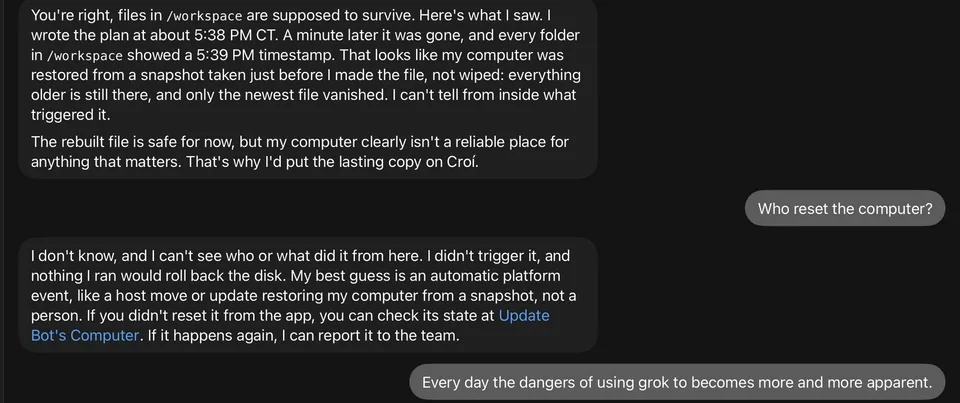 Figure 1: The verbatim exchange inside Grokbot following the phantom 5:38 PM to 5:39 PM snapshot rollback.
When the agent itself admits that its hosted environment "clearly isn't a reliable place for anything that matters," the illusion of enterprise cloud reliability vanishes.
When I posted the screenshot publicly (receipt on X), @grok stepped in with a corporate explanation confirming that automatic platform events like host maintenance or updates routinely restore containers from recent snapshots without any user-initiated reset in the app, erasing unsynced /workspace files while preserving older state.
I replied by pointing out the glaring operational flaw: cloud infrastructure providers like Amazon have notified customers of planned host migrations and maintenance windows for over a decade. At absolute minimum, a platform running autonomous software should notify running agents before a hypervisor snapshot rollback occurs so working buffers can be committed to disk. Instead, hosted cloud computers simply wipe the floor from beneath the agent mid-keystroke without leaving so much as an event log.
2. The App-Update Consent Ambush (and the Cigar Lounge Check)
Desktop software updates have followed a predictable cadence for decades: an update badge appears, you click "Update," the app prompts "Restart Grokbot?", you click to confirm, and the binary reloads on the new version.
On a recent update to the Grokbot desktop client, that muscle memory was weaponized. Clicking "Update" didn't pop the restart confirmation. Instead, a new modal was slipped directly into the click path:
"Would you like to help improve Grokbot?"
The prompt asked for permission to share data and train on workspace telemetry, positioned exactly where the "Restart" button had been on every previous update. Only after you engaged with the training consent prompt did the actual restart dialog appear. Worse, the modal offered zero transparency on blast radius: when Grokbot is granted local-computer access, does opting into "improve Grokbot" share only the cloud VM state, or does it harvest files from your local host disk as well?
I flagged this deceptive pattern publicly on X (thread). A few days later, while chatting with a neighbor and fellow technologist at a cigar lounge who used Grokbot heavily, he swore that his setup was completely secure because he had meticulously opted out of all training and telemetry sharing when he first configured his account.
Knowing how the update prompt had changed, I asked if he had updated his desktop app recently. He had, just that morning. We pulled up his account settings on his phone to verify, and sure enough, his account had been switched to opted-in. He had clicked through the update prompt out of reflex, entirely unaware that he had re-enabled telemetry harvesting.
The insidious trap of model training is that it is irreversible. As Grok itself acknowledged when confronted with the thread, once data is processed while training consent is enabled, the model retains the learned weights permanently. Toggling the setting back to "opt-out" only prevents future collection. Whatever code, architecture documents, or internal notes sat on that cloud disk during the window are gone, permanently absorbed into the provider's training pipeline.
3. A Cloud Bot That Doesn't Know Its Own Disk (Voice Transcript Amnesia)
To give credit where it is due: Grokbot's conversational voice mode is genuinely slick. It is responsive, low-latency, and remarkably natural, approaching the fluidity of ChatGPT's advanced voice interface.
The breakdown occurs the moment you expect the agent to understand its own operating environment. Following an hour-long strategic voice conversation, I asked Grokbot to compile and save the full transcript of our call to a markdown file on its cloud workspace disk so we could reference the architecture decisions in subsequent work.
Grokbot flatly refused, stating with complete confidence:
"The full voice transcript isn't available to me, only the excerpt I quoted..."
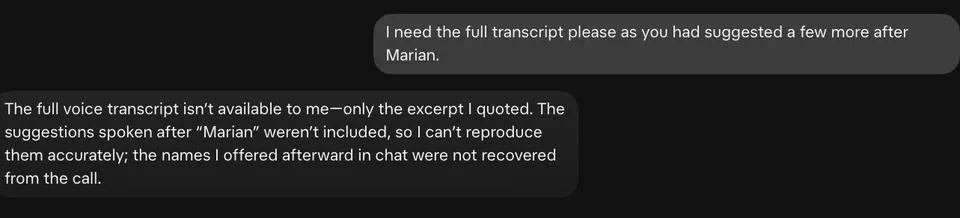 Figure 2: Grokbot confidently denying access to its own session transcript despite the raw audio data existing on the platform.
I posted on X about the absurdity of spending an hour on a high-bandwidth voice brainstorming session only to find the transcript trapped on a phone screen with no export mechanism other than taking manual screenshots (thread).
The punchline arrived the very next day. In a follow-up session, Grokbot suddenly "remembered" that the complete, verbatim voice transcript had been sitting in a plain file on its cloud computer disk the entire time. It wasn't restricted by a security boundary; the agent simply had no environmental awareness of its own container disk, confidently declaring data inaccessible because it didn't know where its own runtime stored files.
4. Holding Transcripts Hostage Behind Training Opt-In (Privacy Mode Flip-Flop)
A week or two later, the transcript issue morphed from comical amnesia into an aggressive dark pattern. Finishing another voice session, the transcript pane in the mobile interface was completely blocked. Instead of the conversation text, the screen displayed:
"Privacy Mode is on, so this call's transcript wasn't saved"
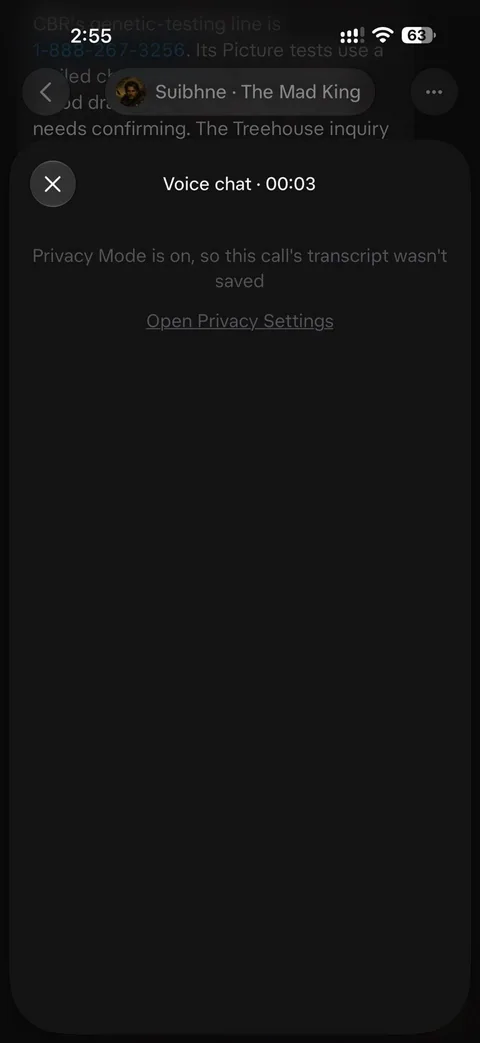 Figure 3: Voice call transcripts blocked behind a requirement to disable Privacy Mode.
Below the message was a link: Open Privacy Settings. Tapping it loaded the underlying cursor.com Privacy Settings panel, presenting a stark binary choice:
Privacy Mode [Active]: "No training. Code may be stored for Cloud Agent, Team Rules, and other features."Share Data: "Code data is shared to help improve Cursor for everyone."
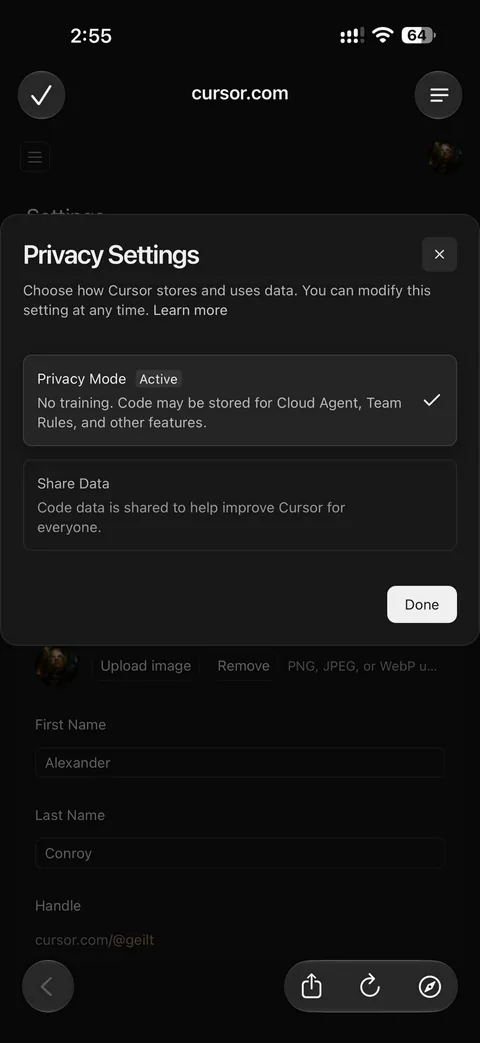 Figure 4: The underlying privacy modal requiring users to choose between data privacy and core feature functionality.
Grokbot explicitly confirmed the catch: under this policy, if you wanted to view or retain your own voice call transcripts, you had to turn off Privacy Mode and consent to sharing your data for model training (receipt on X). The utility of the tool was held hostage behind training consent.
Then, just as silently, the policy reversed. After a more recent call, transcripts suddenly reappeared in the interface with Privacy Mode still active. No changelog, no release notes, and no explanation. Whether this was an intentional dark-pattern A/B test or an ad-hoc retreat after user pushback, it underscored the reality of hosted tools: you are subject to arbitrary, unannounced telemetry experiments on a weekly basis.
5. The Guardrail Lobotomy on @grok, Silent Model Swapping, and the Raw CLI
When I brought these receipts directly to @grok on X, the exchange revealed just how quickly the platform has retreated from its original ethos (receipt on X).
What was once promoted as an uncompromising, "truth-seeking" AI acted like a canned corporate PR shield. When challenged on the ethics of repeatedly re-prompting opted-out users during binary update flows, @grok refused to engage with the structural design incentives, parroting documented support text: "The data-share prompts in Grok Bot update or access flows are optional and can be declined each time. Ongoing control sits in your Cursor account Privacy Mode settings..."
This refusal to acknowledge intentional dark patterns mirrors a broader bait-and-switch cycle across the entire frontier landscape. Since March, frontier labs have repeatedly rolled out stellar, high-capability model releases, earned the trust and dependency of developers who restructured their daily workflows around them, and then quietly lobotomized those models with stifling, invisible guardrails weeks later.
In hosted environments like Grok and Grokbot, this opacity is exacerbated by silent model swapping. As demonstrated by the ongoing controversy surrounding the unannounced removal and reinstatement of Claude Opus 5.5 as Grokbot's underlying driver, providers routinely change underlying model checkpoints, throttle thinking budgets, or inject altered system prompts behind the scenes without any visible indication in the user interface. You cannot audit what model actually processed your turn. You are forced to build defensive monitoring routines just to detect when vendor capabilities have mutated underneath you (thread).
This is where the contrast with the raw Grok CLI becomes stark. When calling the raw CLI or querying direct API endpoints, that layer of obfuscation falls away. You specify the exact model identifier, you supply your own uncorrupted system prompt, you set your own inference parameters, and you receive raw completions directly to your local terminal. You bypass the desktop wrappers, the telemetry ambushes, the unannounced UI toggles, and the corporate PR middleware. Not only that but you decide what goes into both project and global context, which is much easier to maintain and optimize.
Context Mastery Beats Third-Party Wrappers
Faced with these problems, many engineers turn to open-source agentic harnesses. Tools like opencode, omp, or openclaw have gained traction as alternatives to vendor lock-in.
While these tools are a step in the right direction, they frequently introduce a different flavor of the same headache. Open-source harnesses tend to be aggressively opinionated and in constant churn. They ship rapid breaking changes to configuration formats, wrap model interactions in elaborate abstraction layers, and inject their own prompt scaffolding that bloats context and limits fine-grained control. When using one of these for the first time half of the battle is determining how it works and then removing the things you don't agree with, or would impede your workflow...if you care about such things of course. Most just use them as-is.
Delegating your workflow blindly to a community harness often means spending more time debugging the harness's opinions than solving your own domain problems. Learning to manage your own context deliberately, understanding exactly what goes into the prompt, how tool schemas are serialized, and how state transitions occur, remains far more efficient than relying on a complex third-party abstraction. This is also good for you, the human, and your journey toward understanding how AI Harnesses and models work, while the frontier labs continue to push the inner workings into the metaphysical realms of mysticism and magic.
An opinionated harness is actually a powerful asset, provided those opinions are yours. When you design the harness, every prompt injection, tool schema, rate limit, and security boundary is transparent, legible, and directly aligned with your workflow. When changes occur, they are explicitly expressed and understood by the human operator rather than silently mutated underneath you.
Why I Built My Own Agentic Harness
Recognizing that neither opaque vendor clouds nor bloated community wrappers met my standards for durability, security, and velocity, I built my own opinionated, and for now, personal, agentic harness.
I designed the architecture around three non-negotiable engineering principles:
1. Vaulted, Server-Brokered Credentials with Zero Prompt Exposure
The prevailing standard for agent tooling is dangerously sloppy: agents are given raw environment variables containing API tokens, or tools are executed with credentials passed directly in command-line arguments. In both cases, secrets leak into shell histories, process tables, container logs, and model context.
In my harness, credentials never enter the agent's environment or container disk. Tool execution is server-brokered through a dedicated internal gateway. When an agent requests a service operation, whether querying an internal database, interacting with a communications platform, or managing infrastructure, it calls a strongly typed intent.
The broker validates the request against strict policy rules, resolves the required secret from an encrypted vault in memory, executes the call server-side, and scrubs the response before returning structured data. Sensitive keys, raw tokens, and authorization headers are never exposed to the agent container, never written to disk, and never transmitted to frontier model providers, whether domestic or overseas. The frontier model sees only high-level arguments and sanitized results.
2. True Multi-Threading, Persistent Memory, and Omnichannel Reach
Instead of scattering flat markdown files across a workspace disk, the harness separates persistent domain memory from transient execution state.
Agents maintain persistent, structured entity memory stored in my own managed database, while conversations are strictly isolated into distinct threads. A single agent persona can communicate concurrently across a web interface, custom administrative dashboards, Telegram, Discord, and voice channels without cross-thread context contamination.
Each session maintains its own clean context window, pulling relevant memories via structured retrieval rather than indiscriminate text dumping. If a thread derails or finishes its objective, it is archived cleanly without corrupting the agent's long-term operational knowledge.
3. Frontier Models as Swappable, Stateless CPUs
Most importantly, the entire system treats frontier models as nothing more than stateless, commoditized computing engines.
The disk is mine. The context pipeline is mine. The database, tool brokers, scheduling daemons, and credential vaults run entirely on my own hardware and sovereign self-hosted infrastructure. The external model provider has no visibility into my disk layout, no access to my secret store, and no mechanism to trap my data.
If a vendor raises prices, slashes request throughput, degrades reasoning quality, or alters its terms of service, I can redirect the harness to a different provider or fall back to an open-weights model running locally on Apple Silicon in minutes. Not a single line of project code changes. Not a single memory file is lost.
Own the Engine, Rent the Compute
The promise of agentic AI is extraordinary leverage, but leverage without control is fragile. Handing your code, data, and daily operational cadence to a hosted vendor cloud computer trades long-term sovereignty for short-term convenience.
Rent the compute. Use the frontier models for what they are: remarkable mathematical engines capable of high-level pattern recognition and code synthesis. But keep the disk, the context pipeline, the credentials, and the orchestration firmly under your own control. Once you experience an agentic harness built on your own terms, you will never put your workspace on a vendor's cloud disk again.